MANUAL TESTING
Manual Testing Training
Manual Testing
Welcome to the Testing tools course in Vcube. Where you’ll learn to supercharge your software quality. Our course is all about practical tools and hands-on skills that will make your testing process smoother and more effective.
Manual testing : It is the process of checking software by hand, without using automated
tools, to ensure it works as intended.
Automation Testing : It is using computer programs to test software and find issues
automatically.
Testing Using AI : Testing using AI means using artificial intelligence to make software testing faster, smarter, and more efficient by finding problems and checking how well the software works.
Duration: 45 Day
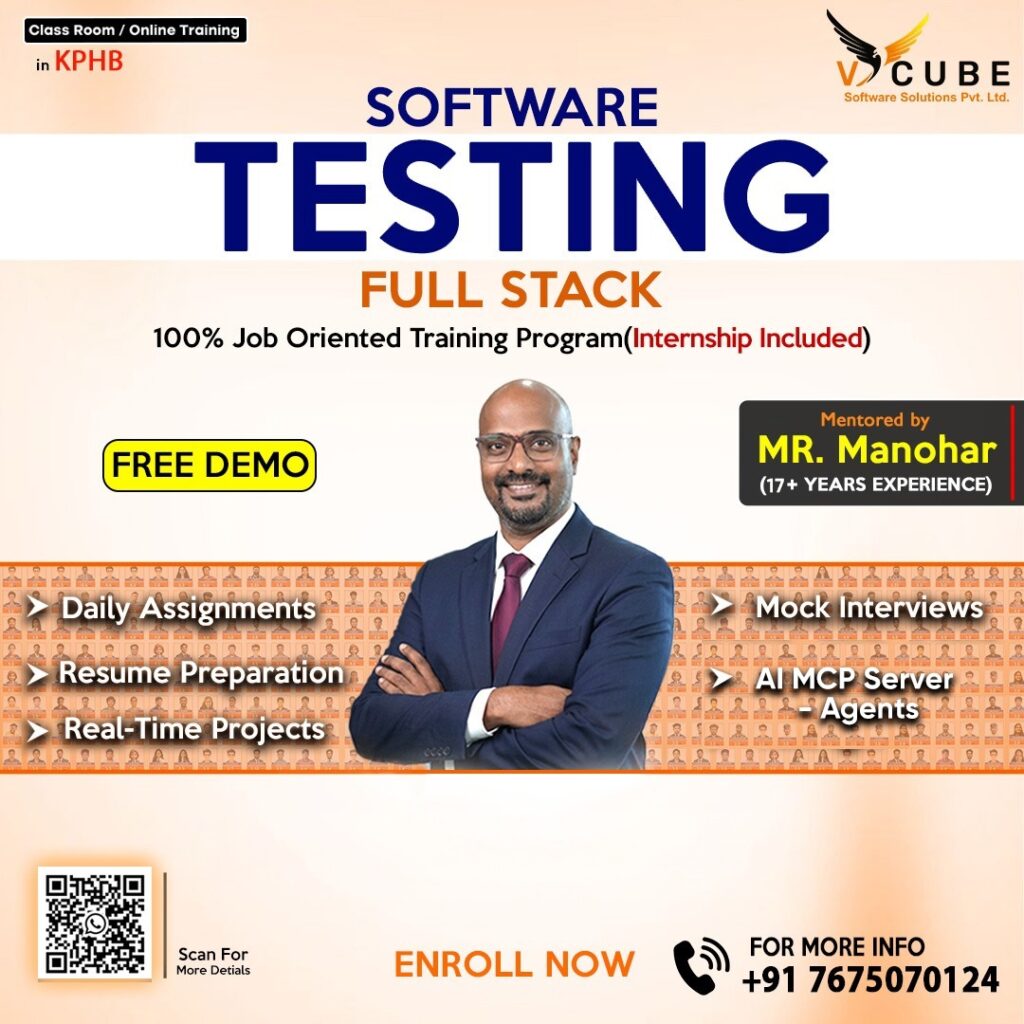

Manual Testing Course's Key Highlights
 100+ hours of learning Real-time industry professionals curate the course.
Internships and live projects
A cutting-edge training facility
Dedicated staff of placement experts
Placement is guaranteed 100 percent Assistance
28+ Skills That Are Useful in the Workplace
Trainers with a minimum of 12 years of experience
Videos and back-up classes
Subject Matter Experts Deliver Guest Lectures
COURSE STRUCTURE
Manual Testing Content :
Week_1 :
- Introduction to Testing Tools
- Types of Software Testing
- What is meant by Manual Testing?
- Procedure in Manual Testing
- Test basis
- Test case specification
- Test scenario, Test cases
Week_2 :
- STLC – Software Testing Life Cycle
9. STLC – Phases
- Requirement gathering
- Test Planning
- Test Design
- Execution
- Test Close Activity
10.Entry and exit criteria
11.RTM – Requirement Tracability Matrix
Week_3
12.SDLC – Software Development Life Cycle
13.SDLC – Phases
- System Planning
- System Defining/Analysis
- System Design
- System Implementation
- System Testing
- System Maintenance
14.SDLC – Types
- Waterfall Model
- V Model
- Iterative or Incremental Model
- Spiral Model
- Bigbang Model
- Agile Model
Week_4:
15.Testing Levels
- Functional Level Testing
- Non-Functional level Testing.
16.Types of functional level Testing
- Unit Testing
- Integration Testing-Types
- System Testing
- System Integration Testing
- UAT – Types
- E2E Testing
- Smoke Testing
- Sanity Testing
- Regression Testing
- Retesting
17.Testing Methods – Types
- White Box Method
- Block Box Method
- Gray Box Method
18.Test Design Techniques – Types
- Equivalence Partitioning
- Boundary value analysis
- Decision Table
- Orthogonal Array
Week_5 :
19.Defect Management
20.Defect Life Cycle
21.Priority
22.Severity
23.Error vs. defect vs. Failure
24.Defect Different Names
25.Defect Analysis – DCD & DD
Real Time Project Steps:
- Assigning Requirement Documents.
- Discussion on Requirement Documents.
- Identification of Test Scenarios and Test Cases from the Requirement.
- Design Test Scenarios and Test Cases in Management Tools – JIRA.
- Do the Requirement Traceability Matrix with respect to Requirement and Test Cases.
- Discussion on different navigations in the Management Tool.
- Testing the application as per the Requirement Discussion.
- Test Execution of Test Cases with respect to Results.
- Test Execution with respect to PASSED and FAILED Test cases.
- Raising Defects.
- Reporting Defects to Dev team.
- Defect Life
Cycle.Week_11 :
1.SQL
- DDl
- DML
- DCL
- Joins
- Star Schema
48.String Methods
API Testing :
Week_1,2 :
1. Introduction to API Testing
2. Testing types using API
3. Architecture Types.
4. Validations carried out
5. Configurations/Installations
- Postman
- Node JS
- Jenkins
- GIT
- GitHub
6. Types of API Requests
- GET
- POST
- PUT/PATCH
- DELETE
7. Parameters in API Request
- Path Parameters
- Query Parameters
- Header Parameters
- Request Body Parameters
- Cookie Parameters
8. Postman
- Validate requests and response from SAMPLE/GITHUB server
- Test case execution
- Generate Reports
- Newman
- Execute test scripts using newman
- Validate Test Case
Testing Using AI – Testrigor :
- Run Entire Manual Process.
- Generating Test Cases with proper Document.
- Generating Test Results with respect to Auto-Generated Test Cases
- AI Generated Test Reports.
Live project
Mock Interviews
Weekly Tests
Soft Skills
Aptitude & Reasoning sessions
- Covering all frequently asked interview questions in Manual , Automation and API Testing.
What you Learn :
- All the terms and terminology used in manual testing
- Detail information on AGILE project implementation using jira
- Effective rating of test Scenario and test cases.
- Strong knowledge on basic java programs
- Active discussion on core java and collections
- Adequate knowledge on Basic selenium Programs
- Strong Knowledge on Basic to advanced level Frame work
- Active SQL testing Sessions and
- API testing using Postman tool.
- Who this course is for
- Complete Beginners
What is Manual Testing Training?
Best software Testing Institute in Hyderabad
V Cube’s Manual Testing Training is designed to teach you how to create Test Cases and Scenarios in depth. Our course is created by the most recent industry advances, allowing you to learn specification-based (Black-Box Techniques) or experience-based (Error Guessing Techniques) techniques while also ensuring Risk Management, Configuration Management, and Defect Management.
This training from the greatest teachers in the industry can help you grasp the current Software Testing techniques. All development cycles, including Agile, DevOps, and the Jira application for test management, are covered in our course.
FAQ'S
Yes. The course is designed for complete beginners and starts with basic testing concepts before moving into practical testing work.
Yes. Students from different backgrounds can start with the basics of software testing and gradually build the skills needed for testing jobs.
You don’t need to be an expert in coding to start Manual Testing. The training begins with testing concepts and gradually introduces the basic programming knowledge useful for testing.
You will learn how to create test scenarios and test cases, understand the testing process, find and report defects, work with different types of testing, and understand how testing is done in a real project.
Yes. The course includes a live project where you work with requirements, create test cases, execute tests, identify defects, and report them as part of the testing process.
Yes. Manual Testing can be a good starting point for freshers who want to enter the software testing field. Building practical skills and understanding real project work can help you prepare for entry-level jobs.
Yes. The course includes SQL and API Testing, helping you understand how testing works beyond checking the application screen.
Yes. The course includes testing with AI, including generating test cases, test results, and test reports using AI-based testing methods.
The VCube Manual Testing course is listed with a 45-day duration.
VCube offers Manual Testing Training in Hyderabad, with its training centre located in KPHB Phase 1, Kukatpally.
Upskill & Reskill For Your Future With Our Software Courses
Manual Testing Institutes in Hyderabad

Quick Links
Other Pages
Contact Info
- 2nd Floor Above Raymond’s Clothing Store KPHB, Phase-1, Kukatpally, Hyderabad
- +91 7675070124, +91 9059456742
- contact@vcubegroup.com